
The XNEW Robotics Pathway
Design, Build & Program Real Robots
A hands-on pathway where students build robots from scratch, master mechanical design and electronics, program with Arduino, and progress toward autonomous and AI-powered robotics.
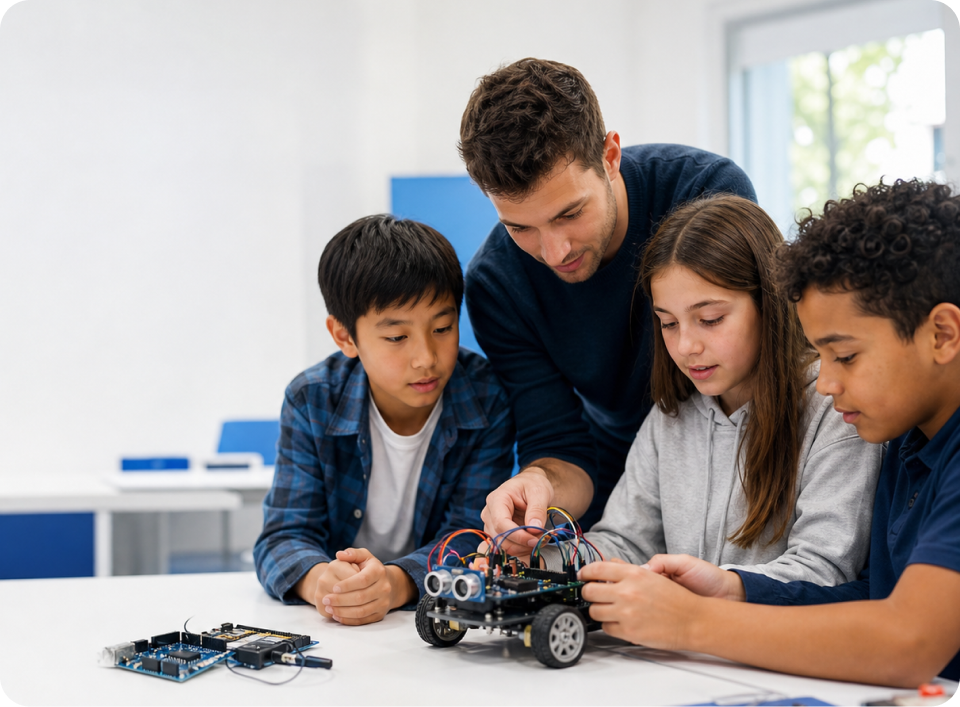
Build Skills Step by Step
From First Build to Intelligent Robotics
Each level adds one essential robotics capability, giving students a clear progression from mechanics and circuits to control, autonomy, and personalized engineering.
Level 1 · Build
Obstacle-Avoid Robot
Mechanics, circuits, sensors, Arduino logic, and the sense-decide-act loop.
Level 2 · Control
Remote-Controlled Car
Wireless communication, controller input, steering, speed, and direction.
Level 3 · Autonomy
Line-Following Robot
Sensor calibration, real-time feedback, path correction, and navigation.
Level 4+ · Personalize
Advanced & AI Robotics
Open-ended robots, perception, intelligent behavior, and custom projects.
Four Levels. One Complete Robotics Journey.
Every level culminates in a real, working robot and helps students understand how robotic systems are designed, programmed, tested, and continuously improved.
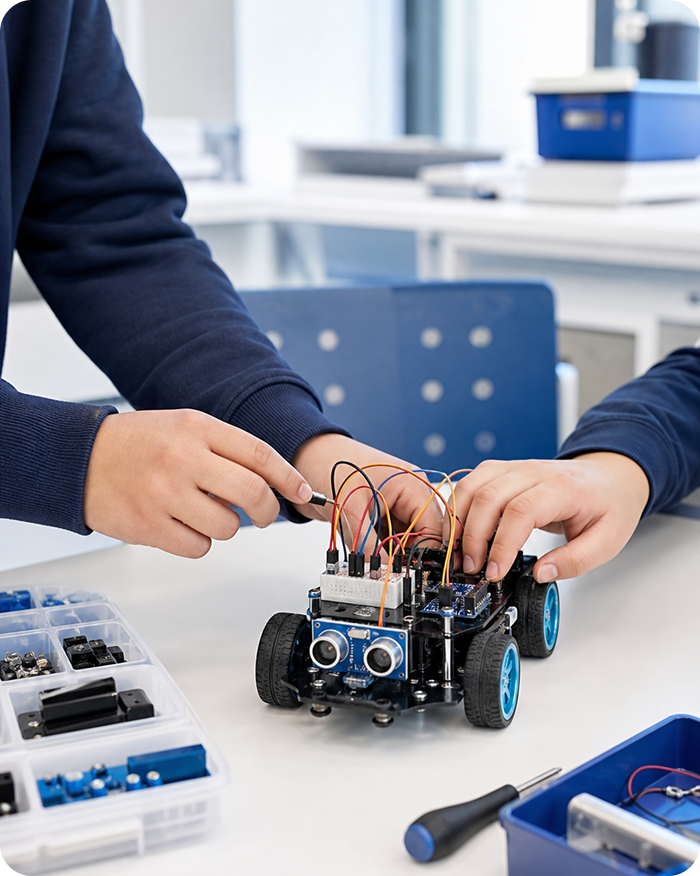
Smart Obstacle-Avoid Robot
What Students Build
Students build a real Arduino robot car with a motorized chassis, sensors, and automatic obstacle avoidance.
What They Learn
- Breadboard basics, LEDs, resistors, and wiring
- Arduino inputs, outputs, analog and digital control
- Ultrasonic sensing and distance-based decisions
- Testing, debugging, and improving a real robot
Outcome: Students take home a working robot and can explain how the sensors and code work together to control its movement.
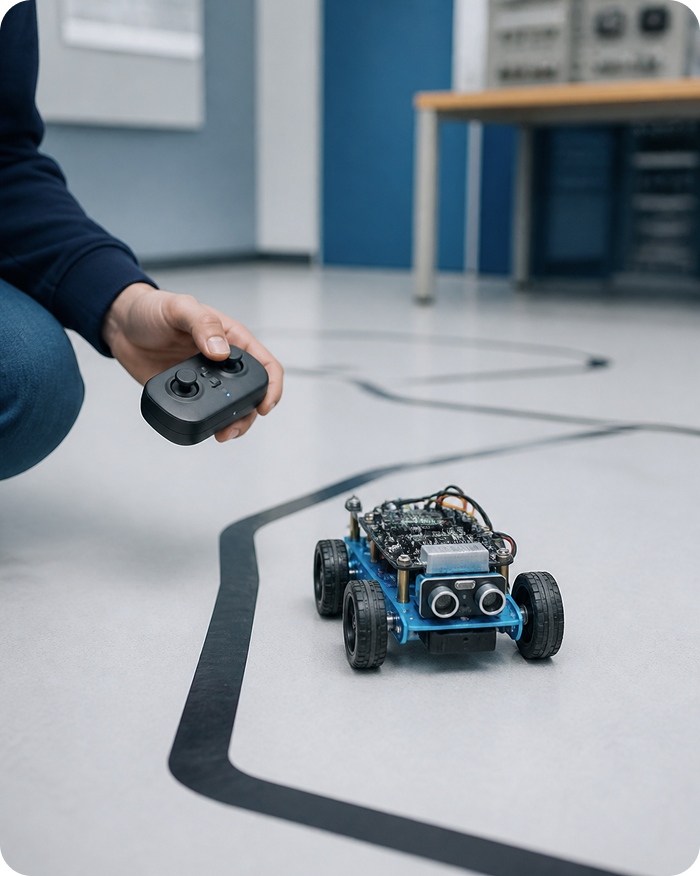
Remote-Controlled Robot Car
What Students Build
Students build a robot car + controller system that translates human commands into the robot’s movement.
What They Learn
- Two-motor driving and steering logic
- Joystick or controller input
- Wireless communication and PWM speed control
- Troubleshooting multi-part systems
Outcome: Students can confidently drive a real robot and understand how the controller and robot communicate.
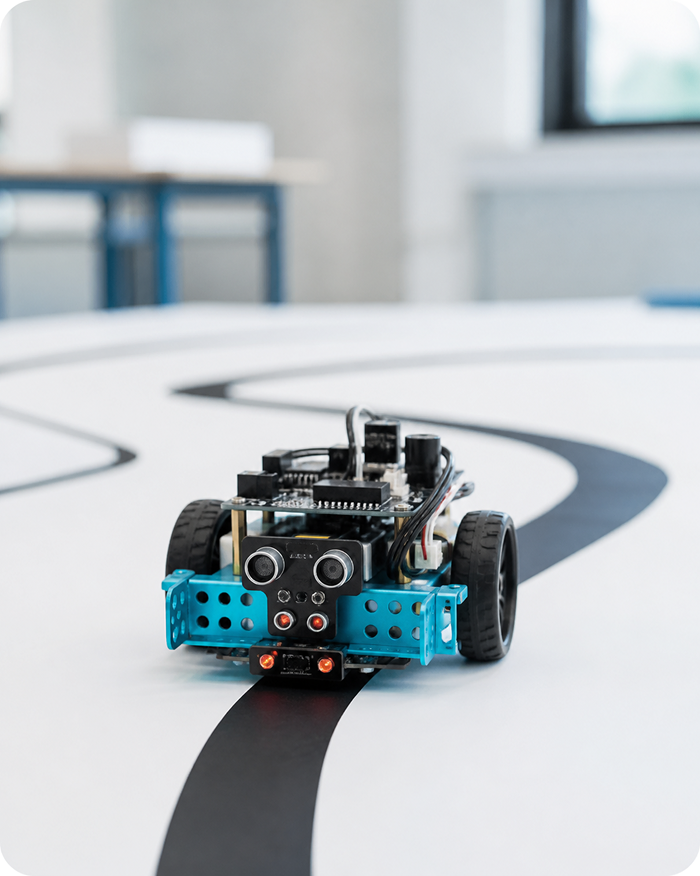
Autonomous Line-Following Robot
What Students Build
Students build an autonomous robot that reads a track and continually corrects its movement through real-time feedback.
What They Learn
- Infrared sensors and sensor calibration
- Correction logic and decision-making
- Performance testing and stability
- Autonomous navigation with real-time feedback
Outcome: Students can implement autonomous behavior and be ready for future personalized robotics projects.
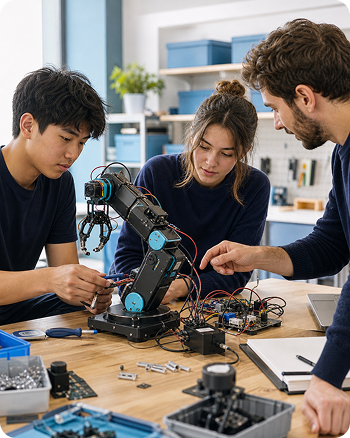
Personalized Advanced Robotics
Choose a Project Direction
Project directions are selected according to each student’s interests.
What They Learn
- Advanced mechanical and system integration
- Higher-level coding, sensors, control, and tuning
- Vision, perception, and intelligent behaviors
- Open-ended design, testing, and iteration
Outcome: Students move from fixed kits toward original Engineering / AI Robotics projects designed around their own ideas.
Why the Pathway Works
A project-based progression that mirrors the architecture of real robotic systems.
01
Scaffolded Learning
Each level adds one core capability, so students build knowledge and confidence without skipping essential foundations.
02
Real Working Robots
At every level, students complete a working project and experience assembly, programming, testing, and improvement firsthand.
03
Engineering Mindset
Mechanics, electronics, sensing, control, communication, autonomy, and AI connect into one coherent robotics system.
Reference framework. The course progression is informed by established youth robotics and CS-STEM education models. It is not an official curriculum of any organization listed here.
From Camp to Competition
A Pathway to Real Robotics Competitions
The XNEW Robotics Pathway prepares students for future participation in RoboCupJunior and FIRST Tech Challenge (FTC) projects.
- Build and debug a complete robot system
- Program autonomous and driver-controlled behaviors
- Integrate sensors, mechanisms, and control logic
- Collaborate, iterate, test, and solve engineering problems
Meet the Robots Instructors

Kim
Cornell University Robotics PhD student with a background in robotics
Kim brings together robotics, mechanical engineering, programming, and AI. Students are guided through the complete Design → Build → Test process while developing independent problem-solving habits.
Course Format
Hands-On, Small-Group Learning
For Grades 5+; younger students may join after a placement assessment.
Start Building
Enroll in Robotics
Choose the Robotics Program below to add it directly to your cart.